
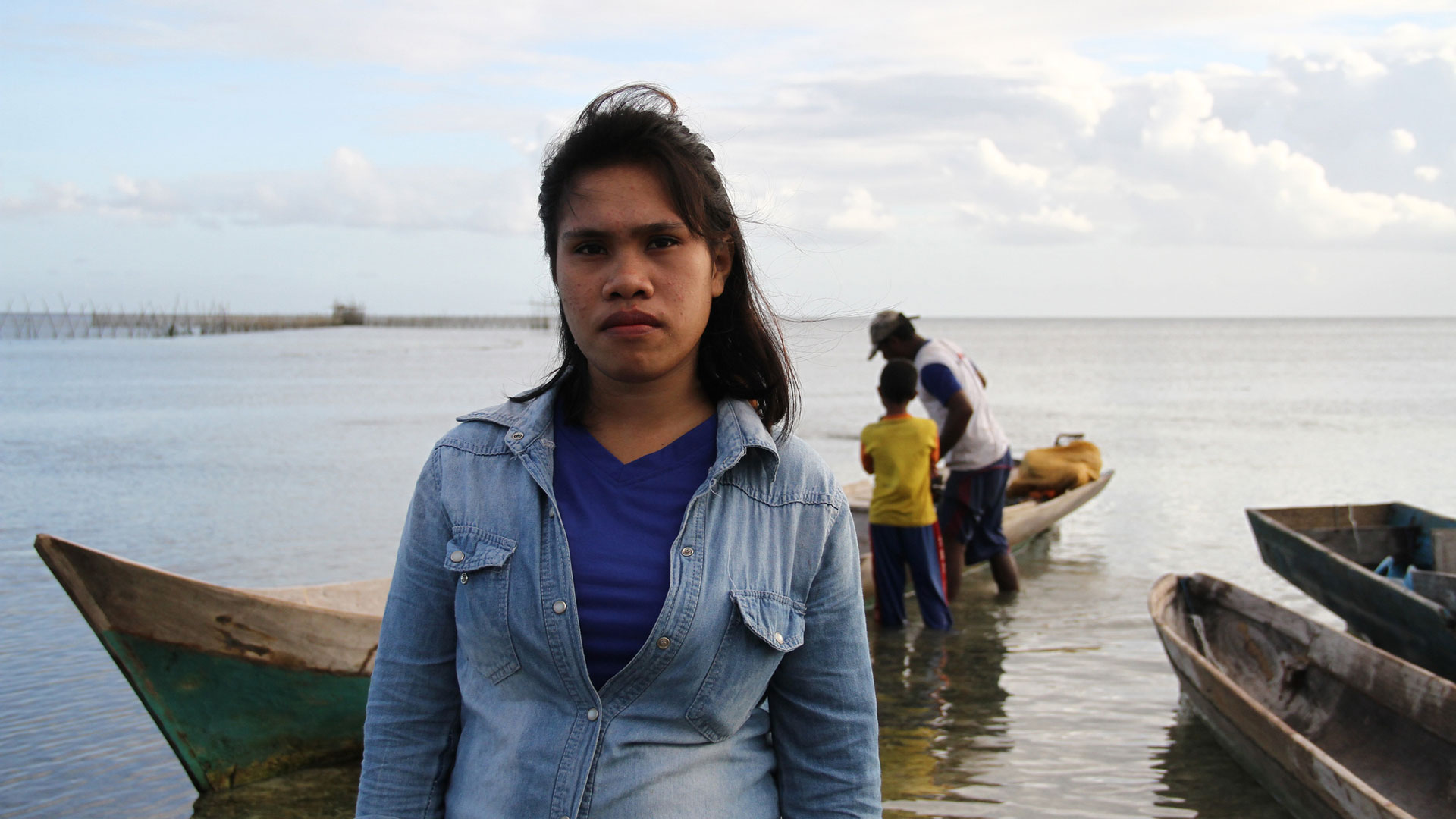
There are two things that shock me after watching Between the Devil and the Deep Blue Sea. First, the invasive violence against women. Second, Ona’s—the subject of the film—strength and flexibility, how she endures, thrives, and overcomes series of obstacles.
In the beginning of the film, Ona is introduced as a young woman who experienced date rape by her male friend, La Nua, during their first night out. “I’m damaged”, says Ona describing herself after the rape, thinking herself to be without worth if La Nua refused to take responsibility through marriage.
This harrowing introduction is then followed by the many struggles that Ona undergoes, in the one-hour long duration of the film, or several months in her real life. From facing La Nua and her parents in demanding engagement, receiving bad grades because of her college’s attires are deemed inappropriate, to being cheated by La Nua who eloped with another woman, all serves as examples on how violence toward women is normalized in our society. It is an important film to be shown to the public, especially during the 16 days campaign to stop violence against women, as a reminder that it is still a very long journey for us (the bill for domestic violence is still far from being passed into law)
However, there’s a distinct perspective that Ona’s story is ironically a counter-campaign for stopping violence against women. My friend posted a startling status once (originally in Bahasa):
“Why are there so many women being hurt, made into fools, but still choose to stay in their marriages? Blinded by love? NO!!! Because they’re good women, and good women consider the happiness of their children, parents, and family before her own.”
It is indeed a fact, that a lot of women choose to maintain their relationships despite experiencing domestic abuses. And not limited to those married couples: take for example Ona, who choose to accepts La Nua, until it is La Nua himself who is leaving.
Sacrifice symbolizes goodness. It serves as a virtue, a moralistic behavior, especially sacrifices that are related to the old teachings. People who sacrifice becomes an example, and women that do so are considered as the epitomes of grace. Just like Sinta, who burns herself to proof her innocence to Rama in the epoch of Ramayana, women today burn themselves in their respective relationships.
On the contrary, some of my friends think that such a choice is stupid. I’m not saying that staying in an abusive and manipulative relationship is something to be imitated. Better alternatives are of course preferable. However often the concept of “alternatives” is non-existent in their constricted world. We need to admit that patriarchy is still a huge part of today’s reality. Even machismo is alarmingly widespread, a concept on the superiority and virility of men, a masculinity that emphasizes the role of men as protectors and leaders of humanity, but sadly manifested in aggressive behaviors: authoritarian control and violence toward women, excessive alcohol consumptions, risks seeking, and animalistic libido.
Sometimes I think La Nua is a victim of such ideology.
Gendered norms don’t discriminate. Men, women, all are subjects to its appetites. Global Early Adolescent Survey (2019) and several other researches find that male and female teenagers are both victims to gendered norms. For example, in male teenagers, it appears through the behaviors of smoking, drinking alcohol, collecting injuries (both deliberate and accidental), that gravely can even result in death. Meanwhile in female, it manifests in early marriage, child pregnancy (under 18 years old), dropping out of school, and it similarly poses high risks for death.
Blum (2019) emphasizes that the lower class suffers bigger losses from the impacts of gendered norms. Although parents normatively profess their support for boys and girls to equally pursue education, GEAS research in 2019 found that the number of boys graduating from high school and entering colleges are higher compared to girls. Boys are feeling pressured to discontinue their education for the inherited responsibility to carry on as the family’s breadwinners. In school’s participation, latest data (Windiarto et al., 2019) showed that girls are bellow boys in junior high school (boys 90,82 vs. girls 92,25), while in senior high school girls are above boys (boys 80,33 vs. girls 81,04).
For the girls’ families, education provides an added value for the “price” of their daughters in relation to their eligibility for marriage (in example belis in NTT and uang panai in South Sulawesi). The higher their education is, the higher their parent’s potential to become rich, in contrast to the lowering of opportunity of boys and girls in achieving their aspirations. Early marriage is one the biggest cause for abandoned education. Even when the percentage of divorce for girls between 10-17 years old is 0,74%, less than 3% able to finish their study in high school level and above (Windiarto et al., 2019). This is clearly a setback. The data mentioning 91% of the girls who married before turning 18 never finish their study (Susenas 2015) shows how big of a problem this is for Indonesia.
The gendered norms set its trap not only to women, but also men. Remember when Ona’s grandma says not to have any relationship with men with certain backgrounds. Meaning that when you find one man is not suitable for you, doesn’t mean you’ll find others that are suitable. The logic also works in reverse. Most of us brought up under similar set of values and norms. Only when there’s an opportunity for knowledge and experience on equal gendered norms, that we can have a new perspective towards better values and norms.
No matter what, life goes on, and often times we need to become a pragmatic getting through it: what works for whom, then reflects on it, how it worked and why. This is seemingly how Ona operates. Life goes on.
I’m in awe with one characteristic of Ona, captured throughout the film: resilient. Ona possess the ability to reign her emotion, control her impulses; not to mention optimistic throughout, able to calmly analyzing her condition, empathetic, sure of herself, and not afraid reaching out to people.
Resilience is a quality of survivor, the capacity to face and resolve life’s difficulty, and then to learn, adapt, and transform through it (Grotberg, 2003: Reivich and Shatte, 2002). Several researches show that resilience is a key element that determines the end result of a difficult situation, resilient people exhibit less of depression and trauma symptoms, even amidst the pressure poses by their problems. The same rule applies to young people, resilience is a mediator between life’s problems and emotional effects they suffer through it (Southwick & Charney, 2012; Olatunji, Armstrong, Fan & Zhao, 2014; Arslan, 2016).
In the middle of the increasing cases of suicidal thoughts, suicide attempts, and even suicides in South-East Asia countries, Ona’s endurance is especially striking. The research of Peltzer, Yi, and Pengpid (2017) finds that college students suicide attempts in six ASEAN countries are related to sexual molestation during childhood and depression symptoms. Ona was raped when she’s yet 18 years old, she thought she was damaged, and without hope. However, she didn’t stopped living, and that alone shows her outstanding resilience.
These are some of the challenges that Ona’s face in the film, and how she copes with each:
- Young Ona, her progressive thoughts often puts her at odds with her mother and father. She chooses to straightforwardly communicate this, that indeed, views can be different, and theirs—her and her parents—are simply different.
- Receiving bad grades while knowing she did well in her exam. Ona chooses to immediately relays the problem with her friends, from which then she collects that in handing out grades her lecturer disregards exam’s points and emphasizes piety.
- Having no money to buy laptop which is necessary for college. Ona chooses to work in an inn to save the money needed for laptop (her parents couldn’t buy her), until she finally able to buy one.
Was she ever troubled? In the film, Ona looks fine, all things considered. Does she ever have thoughts of suicide? Could not be gathered from the film. Either because Ona herself is never overly emotional, or it is the director’s choice to capture it in subtlety.
These three problems exhibited in the film, according to the research of Andrews and Wilding (2004) and Horgat et al. (2018), are enough to elicit depression symptoms to their research subjects. “Financial stress and poor relationship with parents were related to the increasing odd of experiencing depressive symptoms”, they conclude.
Of course, having a differing view doesn’t equate to having bad relationship. It is a fact that can be seen in the film, Ona’s parents are still providing advices which Ona considered. Bringing Ona to a religious figure to be prayed for is an example of her parents’ concern, them hoping it can cure her sickness, and ‘wildness’. Ona herself, even as she thinks of the effort as useless, still chooses to comply. Ona still call on her mother asking for help in the face of her lecturer’s extortion. When her father—according to her mother—shutting himself inside the house out of fear of his accumulated debts to the neighbors, Ona could sympathize, even when her mother ‘curse’ her with karma after Ona uses her allowance money (hard earned by her parents) to support La Nua. This bond with her parents is seemingly one of the factors that builds Ona’s resilience.
How Ona deals with her rape shows that she has a problem-focused coping strategy, not only emotion-focused coping strategy. She directly targets thing that troubles her most, with going to La Nua’s house, exposing him, and demanding La Nua to take responsibility by getting engaged with her, without telling a single thing to her parents.
Research conducted to undergraduate students in Spain showed a linear and positive correlation between resilience, deep learning, and problem-focused coping strategy (de la Fuerte et al., 2017). In Indonesia, a research on teens experiencing cyberbullying also showed a positive correlation between resilience and problem-focused coping strategy (Tantri, 2018).
But what is it exactly a problem-focused and emotion-focused coping strategy?
In popular psychology, it is often mentioned that men and women have a basic characteristic and behaviour differences. John Gray, an American family counselor, popularized the saying, “Men are from Mars, women are from Venus” to describe these differences. Generally, men are thought to be more rational, while women more emotional. It is also the case with coping strategy. Around two or three decades ago, in another part of the globe, men were found to be inclined toward problem-focused coping strategies, while women toward emotion-focused coping strategies (Endler & Parker, 1990; Matud, 2004; Ptacek 2004; Ptacek et al, 1994).
Confronting seems like an emotional action; however, it can also be a form of carefully thought coping strategy. To make sure La Nua and his parents take responsibility. It won’t necessarily result in agreement if Ona talk kindly and beg La Nua to marry her.
Being engaged, without telling the reasons to her parents, is possibly a move to minimize potential problems. It is my set of assumptions, that Ona knows perfectly well how her parents will react to the knowledge that their daughter was raped. If Ona can see better alternatives, she will most likely do it, and this is also the case with her other problems.
It is quite the common occurrence that problem-focused coping strategy employed side by side with emotion-focused coping strategy, for example when Ona doesn’t take it to mind the negative sayings of the village’s little kids about her and La Nua, or when she accepts her grandmother’s remark to not having a relationship with people from La Nua’s village in her way of acquiescing Ona’s unhealthy relationship with La Nua.
At a glance, it is easy to assume that Ona breaks the stereotype of coping strategy based on gender. She’s more rational, although not without emotion, and she’s not alone actually. A small research conducted on college students in Bandung showed similar result. Male students working on their final paper mostly used emotion-focused coping strategy, while female students under the same circumstance used problem-focused coping strategy (Kartika, Derja, Ruhansih, 2018). Are the challenges and problems faced by modern women (young women) shaped their coping strategy toward problem-focused? This could be an entirely new research topic.
It is easy to imagine that late teens (late adolescent, about 18-22 years old) with the habit of attributing themselves as the source of their problems (self-debilitating attribution) are often not resilient. The feelings of inadequacy and uselessness stop them from developing into a tough individual. In this aspect, Ona is different. Cursed as trash by La Nua’s parents, and thought as wild by some of her closest friends, Ona’s external attribution in telling her rape story and toxic relationship with La Nua is a rational and healthier choice. In dealing with persistent challenges and problems, oftentimes impossible to change, attributing problems externally is a way of evading self-abuse. In a world where the tendency is victimizing victim, many of the female teens who are victims of sexual harassment directed the blames toward themselves, thinking it’s their faults because they, for example, are wearing miniskirts, are allowing themselves to be taken into quiet places, are not refusing mingling through dance—it will then escalate into the increase likelihood of getting sexually harassed in short period interval (Miller, Markman, Handley, 2007).
Social capital, relation between individuals and communities—including norm, common value that can bond homogenic society or bridge it to the outside world—is one of the important foundations in building resilience. The norm and value of Ona’s village in Kaledupa are seemingly at odds with Ona’s. However, even in such circumstance, Ona’s bond with her family remains steady. Outside all of that, Ona has a best friend named Dewi, who is also her college friend in Kendari, to whom Ona relays her woes and struggles. Ona’s college environment in Kendari seems to be more in line with Ona’s own norm and value compares to those of Kaledupa. The presence of these two worlds provide Ona with choices and supports she needed.
So, what can I gather from this film?
I can see Ona overcomes obstacles to be who she is, struggling to break down the walls that confine her from self-actualization. I also see how Ona is divided between her own modern perspective and the surrounding traditional view, a constant struggle throughout the film, between freedom of self and obedience to generations of long-standing norm.
I see Ona, a young woman, strong, empowered, journeying into adulthood with a strong sense of self, emotional stability, clear life purposes, understanding of self-value, and awareness that relationships is not only about physical intimacy, but also emotional. Way to go, Ona!
Abigael Wohing Ati, an avid learner especially on fields of psychology and sociology. She’s currently working on her PhD.