
By: Rasella Malinda
Ona is contemplating. She is puzzled. She has made all her best efforts to meet Mr. Jahada’s lecture expectations. From submitting assignments, attending classes to taking examinations. But Mr. Jahada still gives her an E. He told her it is because she dresses too sexy, and she is not good at reciting the Quran. What a rubbish explanation! How can one’s intellectual capacity correlate with their dressing choices or their ability to recite holy verses? The only logical way for the lecturer’s absurd reasoning is by exploring how today’s social construct shapes the behavior in our society. Such as what is acceptable and what is not, what is proper or improper, what is polite or rude, and other binary concepts attributed to specific gender roles. This documentary film, “Between the Devil and The Deep Blue Sea,” captures this phenomenon in such details. Scene by scene, it invites us to unravel Ona’s struggle throughout her transition phase to become a young woman.
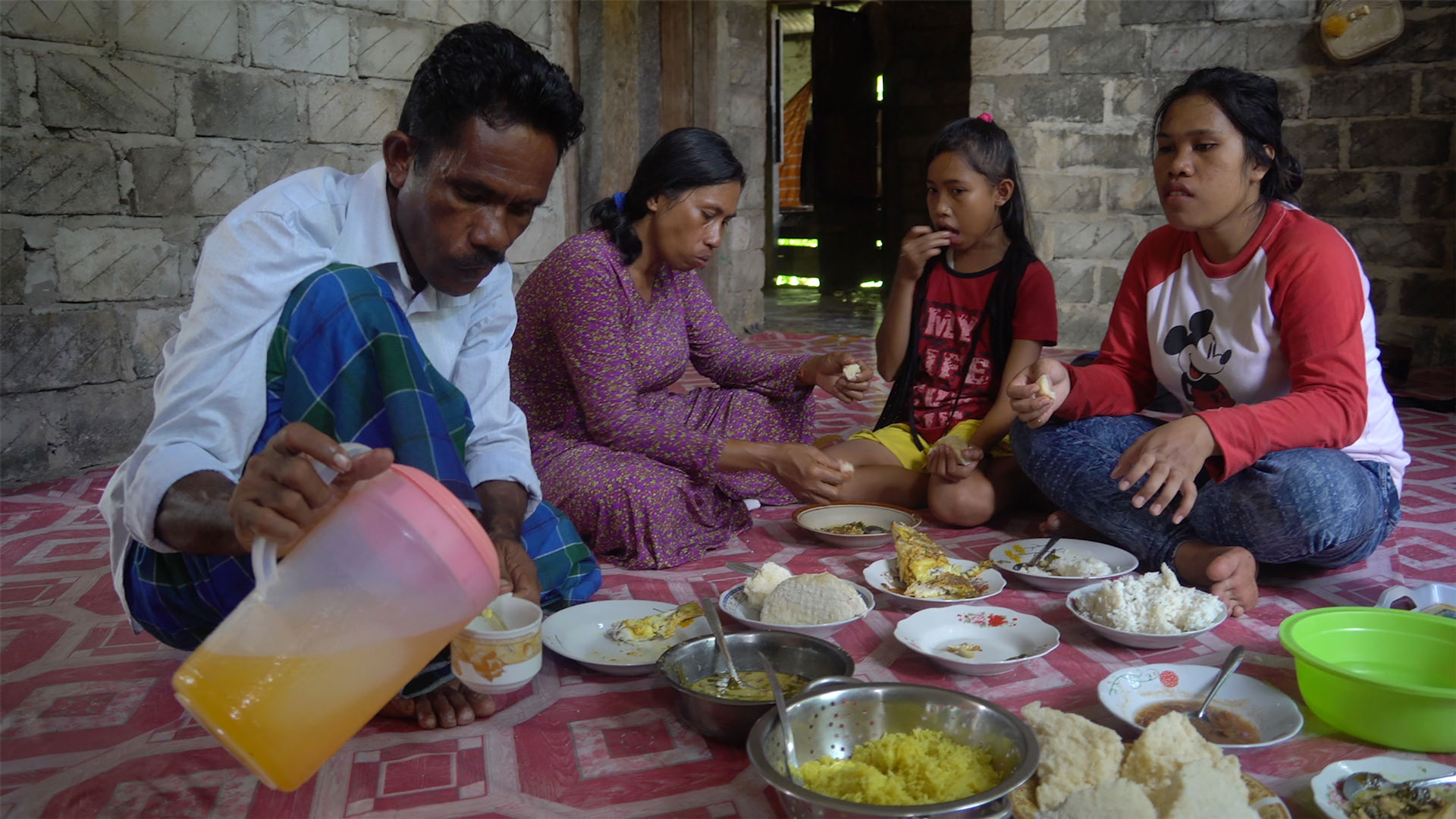
Portraying the life of young girls in a rural area
Observing Ona’s twisted journey to adulthood had reminded my time spent on fieldwork at Liang Buaya, a fishermen village at East Kalimantan province during 2016-2017. The fieldwork duration was one and a half years, and during that time, I stayed with Mr. Wandi and Mrs. Jus’ family at their raft house. They had five children, three of whom were females, Nila, Neli, and Juang. Sis Nila was already married (meaning she’s bound to domestic responsibilities), while Neli studied in the district’s capital city. Therefore only Juang was available most of the time to accompany me during fieldwork activities. Juang was born in mid-2001. Ona reminds me so much of her for their rebellious trait. They are both stubborn, outspoken, and outgoing when it comes to a relationship with other people. Juang, just like Ona, was also on her journey to find her identity, one of which through interaction with her peers, particularly boys. I found Juang often conflicted about choosing between her aspirations and what the norms expect her to do as a teenager. She didn’t hesitate to take the initiative and express her feelings. She is bold enough to refuse boys who did not meet her criteria. Sometimes, her choices resulted in risks (although not as complicated as Ona’s). Still, just like what other teenagers typically do, she is not afraid to bend the rules to find possibilities.
Liang Buaya represents the dynamic of multifaceted problems that intersect one another in many rural areas in Indonesia. Rural areas are no longer fit to the image of a romanticized sphere where singular society exists, or where the processes of socio-economical differentiation do not occur. National Statistical Bureau (BPS) reported in March 2019 that the percentage of poor people living in a rural area was twice those living in the urban area. Although the number showed a decrease from the previous years, it hardly changed the economic struggle that the communities had to endure every day to make ends meet. Liang Buaya, for example, is a river village where fishing is the community’s primary subsistence activity. Today, they live on the edge of ecological destruction caused by a massive expansion of palm oil plantation in the area. It causes river pollution and damages the turf swamps ecosystem.
The river ecosystem provides ecological support to the Liang Buaya community. When it’s polluted, it makes the community subsistence becomes more vulnerable. A study from Rumah Kitab in April 201611 conducted in nine areas in Indonesia showed that ecological damage contributed to the number of child marriages. Critical findings from this research show a correlation between the phenomenon of land-use change and the narrowing job opportunities, migration, and change in gender roles distribution in families. In rural communities, land commodification due to investment and construction projects has increased the number of family migration (father and mother), resulting in daughters taking over more roles from their mothers. It forces them to drop out of school or to get early marriage. In Liang Buaya village, child marriage is also seen as one of the solutions to overcome the family’s economic burden.
Moreover, the lack of proper reproductive health education at schools has contributed to the high number of unwanted pregnancies in young girls, which forces them to end up in marriages too. The patriarchy construction that rooted deeply in rural communities who limit women’s role only at domestic domains has also contributed to sustaining child marriage practices. This situation is shadowing Juang, Ona, and many young girls in Indonesia’s rural areas today and their struggle to fulfill their potentials.
Getting to Know Ona
Under the threat of a knife, Ona, who was still a high school student that night, was forced to have sex with La Nua on their first date. She was frightened but also angry at the same time. La Nua left her in confusion; about how people or her family would mock her if they find out about the rape, about the fear if she were pregnant, about how he made her felt like trash. Ona thought the only way to save her and her family out of shame was by asking La Nua to marry her. This act would conform to the community’s expectations too. But this also was not easy. La Nua refused to do so. The situation made Ona burst in anger and scolded La Nua in front of his family. “My life ruined because of you!” she yelled. After that incident, a decision made between the two families. Ona and La Nua were engaged.
The opening scene of this documentary delivers a strong impression. It brings us to the center of Ona’s struggle as a teenage girl from a coastal village. Us, the audience, could gather information about Ona’s character, a brave and stubborn girl, from the way she speaks. Ona grows up in Kaledupa island, part of Wakatobi islands, Southeast Sulawesi. Living by the seaside, her knowledge of the ocean and marine resources has grown organically. It’s not a coincidence for her to pursue her dream as a marine biologist. Thus motivates her to study in the Faculty of Marine and Fisheries at Haluoleo University. Despite her family’s financial limitation, Ona’s parents willing to support her dream. It means it includes the support to postpone her marriage. We are awed both by Ona’s resilience, but also by her rebellious trait that is sometimes borderline obnoxious or worrying. As the audience, we witness a journey of transformation and hope. One important note, this documentary is crafted with optimism and good intentions, sending out a message that no matter how difficult life is, there will always be a path to follow through. And the film guides us to it step by step.
Meanwhile, La Nua, who just got released from jail, came back to Ona’s life again. Ona, who was happy, suddenly became dominated and permissive. In one of the scenes, she clips La Nua’s nail with a lot of affection, trying to fulfill a role in how a good fiancee should behave. That scene reminded us of the motive behind that behavior. On the introduction, Ona mentioned her fear of her view on how patriarch myth measures woman’s morality based on her virginity. Ona is not alone. Many other young women have to give up their dream because of this myth. It leaves them with no choice but to get married, despite their unreadiness.
The Problematic Ona
Often, I found, Juang, my host sister in Liang Buaya village, was behaving recklessly. One night she went out to see a local music concert without informing me, who at that time was in charge of her. I couldn’t sleep all night waiting for her to come home. The thought of Juang was still out after midnight made me restless. At 3 in the morning, she returned home with her girlfriends. She innocently asked for apologies, and yet couldn’t stop giggling. I was furious at her. Didn’t she know how dangerous it was for her? Later on, I reflected maybe this is how a mother would feel for her daughter. Realizing how to worry I was, she started to behave and said she was sorry, and she wouldn’t do it again. Nonetheless, she kept doing things that put another people’s patience to test.
Ona has the same tendencies as Juang. I am sure the audience is caught in disbelief when Ona sells her laptop for La Nua, her useless fiancee. Or when her mother scolds about her karma. We are sure, that time Ona has crossed the limit. She has wasted her parents’ sacrifice for the man who despises her. To her parents, it costs them an arm and a leg to buy a laptop. But they are willing to do so to support Ona’s study. Thus, it would be challenging for Ona to regain her parents’ trust. The only thing she could do is to show that she would learn from her mistakes.
When La Nua disappeared, it was a relieving moment for us the audience. Finally, the devils have gone. But at the same time, we are wondering about how Ona would react. Would she feel sad or despair? Would she express her anger to La Nua’s family? Here we witness Ona’s transformation. Throughout many hardships in her life, being a survivor, discriminated by her lecturer, lost her parents’ trust, had a tumor, and left abandoned by La Nua, those experiences compel her to reflect on her life. Although she never openly regrets her choices, we could sense her deliberation through her decisions.
Ona’s parent plays an essential role in her journey of becoming. Without her father and mother, Ona might not be able to reflect on her experiences. Though the family was poor, Ona’s father has never seen to ever complained. He would sell or do any type of work to ensure her daughter could go to college. Is it possible that this film has the purpose of breaking the patriarchy myths where a daughter would only end up in domestic roles, so there’s no need to send them to school?
Giving Ona a Chance
One of my favorite scenes is when Ona joyfully kisses the replacement laptop that she buys with her own money. She is proud of her hard work and tells her best friend that it is one of her life’s best achievements. She could redeem her mistake and gather her parent’s trust again after she sold her previous laptop for La Nua. The scene took place at the end of the film, and I recall one of the producers said, “Ela, I think you will like the ending.” I’m not sure if she meant the same ending, considering the production process not yet completed at that time. But clearly, I favor this part. Even though I realize, Ona’s story has no intention to be one with a happy ending. It is developed organically and grounded firmly to reality, far from dictating or imposing any kind of moral message.
I started to imagine what if a different team or director developed this documentary? Would they be able to depict Ona’s struggle with all the complexities of her character? Or, most importantly, how it would narrate Ona’s critical transition during her most vulnerable phase?
Dwi Sujanti Nugraheni, the director, did not rush the process to develop the film narration. Instead, she patiently took her time to approach while providing space to Ona to be the storyteller of her own life. Sometimes, I portray Ona as local ‘Christine’ from the movie Lady Bird. A more reckless and stubborn one, especially when it comes to arguing with her mother. The scene when she feels possessed by an evil spirit and undergoes an exorcism practice is one highlight of the documentary. I think that is the best part anyway.
Dwi captures Ona’s moments of struggle with such a unique point of view. While another documentary narrates through text or verbal statements, Dwi chooses facial expressions to deliver emotions. I enjoy Ona’s daydreaming face, her cry of joy, her anger, and her laughter when she feels satisfied as well as her confusion when facing uncertainties. The film presents Ona as humane as possible, with all the complexities of her puberty phase.
Maybe that is how things should be. A young woman needs to have space to learn and to actualize herself in her most crucial period in life. Many women have got various stigma from society; about how they treat the women bodies for the standard of morality. How young girls’ future is fixated on the set of domestic roles, and for many, how their dreams would end in marriages. Or in Ona’s case, it’s how her intellect assessed from the way she dresses. Even Ona is lucky in some ways. She is supported by her friends and family, and she is resilient enough to keep her goals alive. Thank you for presenting Ona. Through her and beyond her.