
By Andi Fatimah Azzahra
Her story began that night. The sound of the ocean waves was the only witness when the incident happened. A nightmare for the defenseless, women who rely to no one but themselves for protection.
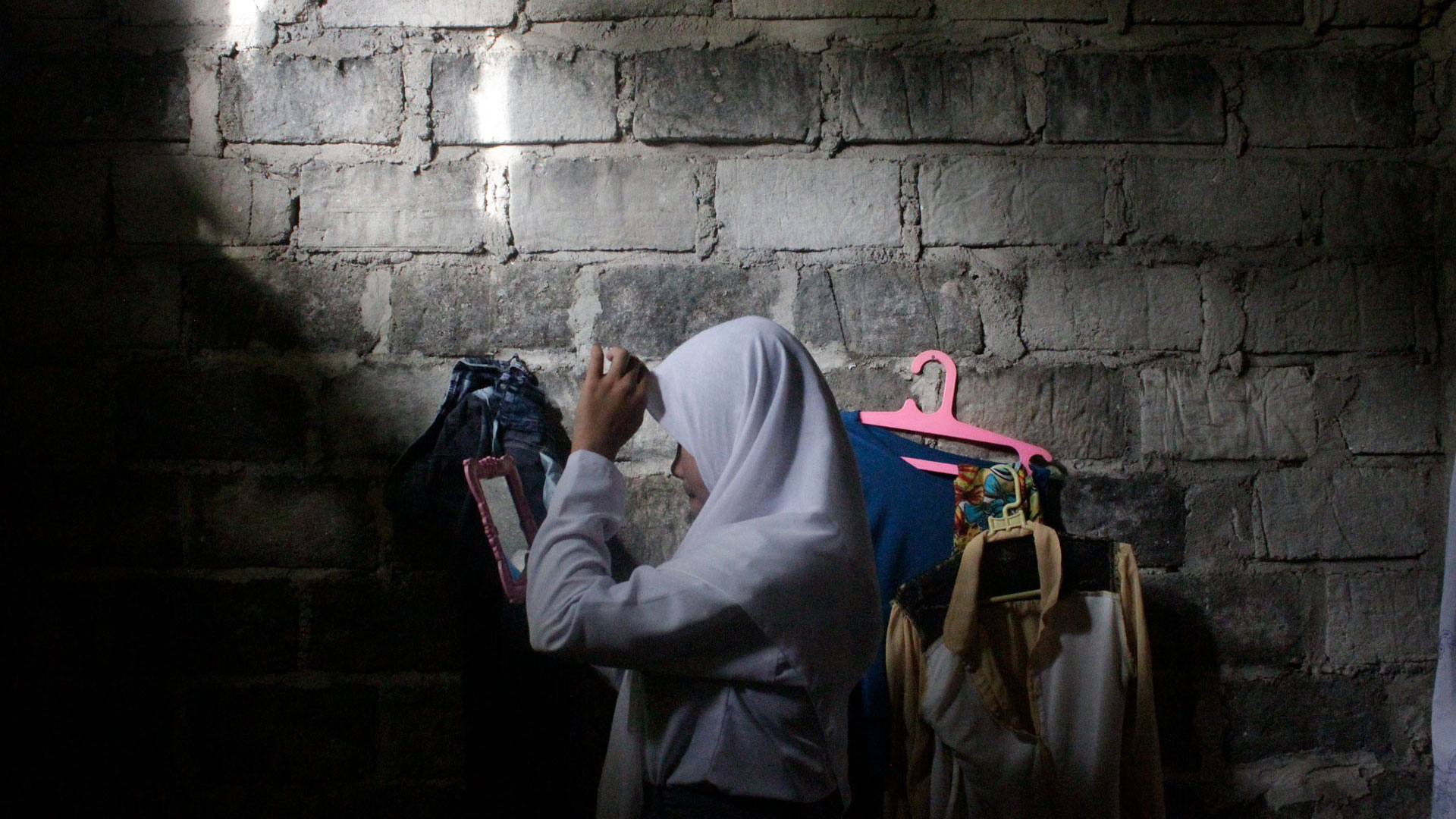
Ona is a teenager from a coastal village of Kaledupa. She is a student at a university in Kendari. When she was in high-school, she was raped by her date, La Nua. She thought that she was pregnant. Thus it forced her to get engaged with him, the perpetrator. Otherwise, the burden of public shame would be doubled for Ona and her family. However, engaging to La Nua comes with another problem. He is known as a local thug, and Ona’s life will be stuck with his reputation. There’s not much to choose for Ona as both options would result in hardship. That’s why the film is titled “Between The Devil and The Deep Blue Sea” (2019).
The majority of Kaledupa people have historic background from the Buton sultanate, South East Sulawesi. At present, Kaledupa community still holds the Islamic traditions, values and norms closely. In particular, norms on the position of women in the society. Clearly in patriarchy culture, those values are considered as good intentions to protect the women. In their culture, the figure who enforces those values is called a ‘lebe’; the brothers and the parents. Lebe is a community figure. He occupies the role as leader for traditional rites or religious prayers (Hindaryatiningsih, 206: 108-115). Local values such as obedience is mandatory for young generation, men are the breadwinners, the explorers and the centre of ideology. While women are the main instruments of domestic households (Murniyati and Burhan, 2016). With the passing of time, women begin to occupy double roles. It causes frictions between the norms and the need for economical income. In between those tensions, Ona grows as a young woman and battles her faith with La Nua.
Ona is a character of strong opinion. She is able to communicate her view clearly with her parents. This causes ongoing differences between them. Some points of disagreements become defining for her. Her parents think she is lazy. They think Ona is too ‘wild’ for her liking to dance at local live music shows. But Ona always has a way to talk back to her parent.
Ona has the ability to make bold statements, one of which,“We have different way of thinking. If I could bring all the rice, the bed and the table, I would. So I don’t need to buy anything there. But it’s not possible because I will transit at several places for an unpredictable duration.”
The statement shut her parents’ argument because they’ve started to understand the journey that Ona has to take for her study at Kendari. This observatory documentary is succeed to present the dynamics and the essence of a character’s life. A purpose that a film, as a medium with limited duration, aims for.
Ona’s conversations with her parents are somewhat entertaining. It’s a mixed feeling to describe their love and relationship. The Butonesse (Wolio) are familiar to open discussion in its social institutions (Hindaryatiningsih, 2016). Ona and her parents are quite open in communication, for example on her study subject (Marine Biology). Ona’s father is able to intervene Ona’s laid back habit significantly. Their conversation was started sternly. But it was ended with open statement from her father. A subtle way to convey his message to Ona. Although seems to be open-minded, we witness conventional traditions are still practiced in the family. For instance, when Ona’s mother brings Ona for ‘ruqiyah’ (exorcism) to a religious leader (Lebe). This is believed as a solution to Ona’s problem. The scene is hilarious to watch. Not only for Ona who looks convincingly possessed, but also for her mother’s reaction.
She tries to be the person of reason for Ona, but at times she is conflicted with her belief and traditional norms.
Dwi Sujanti Nugraheni is able to capture the complexity of Ona’s life, in both satire, yet thoughtful way. She positions herself as neutral as possible to Ona, her world, her parents and her self contradiction. Particularly, when Ona’s choice to get marry has no effect in La Nua’s life. He’s still get away as a free man after all. Even after he got out of jail for stabbing a person. Or after the rape. As if the engagement and the marriage are able to eliminate what happened that night. Have we ever thought how the society forces a person to marry her perpetrator and make her believe it’s the right thing to do? Have we ever thought about the kind of life she will live on? In this case, Ona’s life with La Nua. For Ona and her family, justice is nowhere to be reached without condemn and public humiliation.
According to Women Well-being’s Index report in National Geographic magazine (vol. 11, 2019), there are three categories to measure women empowerment, namely justice, security and inclusion. They are divided into 11 sub-categories: legal discrimination, son bias, discriminatory norms, organized violence, community safety, intimate partner violence, education, financial access, employment, cell phone use and government representation. Indonesia was ranked 95 out of 167 enlisted countries. Yemen, Afghanistan, Syria, Pakistan, Nigeria and other 9 countries including Somalia occupy the bottom positions. From the above mentioned sub-categories, Indonesia is still lack behind in education, financial access, employment and community safety. The worst points are government representation, discriminatory norms, legal discrimination and community safety. How is this possible?
Special train wagon for female is seen as innovative policy in Jakarta. But what about those who reside outside the capital? Women and girls who live in rural and surrounding urban areas? Is hijab, niqab and multiple layers of clothes enough to protect them? Why is no shame for them, perverts or sexual predators, when women are the ones who have to cover their skin so they could control their ‘desire’? Even when it is subtly covered in look, sayings, hand gesture, joke, praise or intimacy, sexual harassment in any forms, has always impacted negatively to women.
Nowadays, women also carry double burden of their domestic and economic responsibilities. Everyday, they have to endure sexist jokes, verbal or physical harassment in their working environment. Most of the institutions (and yes, including educational ones) maintain ‘silence policy’ due to imbalance power relation and objectification to women. Women have to build protection for themselves by being invisible. Otherwise, they have to undergo hard consequences and discriminatory norms, just like what happened to Ona in Kaledupa village.
Rape case on the street is seen as normal. “That’s what happens when women are alone in the street,” they said. In the end, the victim and her family will settle the case down with the perpetrators and his family. Case closed. Only when there is a controversy of serial rape killers, the news would go viral. People would talk about it for a week. A ‘sudden bill’ would be passed on to instantly ‘resolve’ the problem. The underlying concern of the trial would be far from fair, let alone the sentence. The case is over. But the next question is, how do the government and the society present in that situation? When the exposure starts to subdue and people return back to their daily life? Do all young girls have to be like Ona? For me, the marriage looks more like self-punishment. Without proper knowledge on sexuality, Ona becomes more vulnerable in every decision she makes. Moreover, she is totally alone when it comes to challenge taboo in sexual education or conversations. By neglecting her situation, we can say that as a woman, Ona is raped by her country.
In the patriarchy society of Wolio or Buton and its surroundings, we can find folklore text (Wandiudu) and oral traditions that depict man power as domination, arrogance, tyrant or even physical violence in its manifestation (Karim, 2005). Symbolic violence occurs in daily functions in patriarchy culture, and it’s the most difficult type of violence to address due to the absent of physical injuries or traumas. The victims are not always aware of the domination or objectification. This symbolic principal is known and accepted by both the superior and the inferior.
I have always been cautious with any discourse or reference related to gender issue, particularly by firstly examining the context of the given society. It includes when I watched Between The Devil and The Deep Blue Sea. It will be too easy to point out at patriarchy culture as the root of the problem.If it is not comprehensively approach, we will risk to create another problem. Gender role distribution in Ona’s family is rare to find. In this film, her mother and father have equal and complementary roles in raising their children. The father is able to nurture his daughters, and at the same time become a charismatic leader of his family. But what about other families who do not have such figure? Or families with close-minded, inflexible and authoritarian men figures? While in reality, those families live in society with dynamic cultures and human relations.
Technological advancement and economic growth have to take gender inclusion and non-objectification into account. Inducing knowledge on sexuality and balanced gender roles, both at formal and informal education will effectively institutionalized the values. We need to reassess common belief and values at different layers of society to ensure they are comprehended and practiced contextually. Contributing to a more developed culture. Transition processes in life require individuals to adapt to changes. Runyon and Haber (Irene, 2013) described that problems are inevitable in order to fulfil our goals and self-adaptation is a state of being or a process. People continue to alter their life course in line with their environment or living situations. Individuals change their life purpose along with the changes that happen surround them.
Such hope is possible only if the processes of social change are assisted and supported with full awareness from the multiple stakeholders. Particularly, in areas where sustainable development that based on cultural diversity is not present yet. If those fundamental processes are done consistently, the real impact will take place in communities. Women and children are supposed to feel safe, wherever, whenever, with whomever they meet. Masculinity, if only perceived from single dimension, inflexible and misunderstood would also lead to another problem. A friend who works at the MInsitry of Women and Child Protection recently shared that cases of child molesting (adult male to young boys) have increased. Children are generally not equipped with knowledge in sexuality. In many cases, young boys are taught not to show weakness and to adopt masculinity in many forms that are collectively approved.
In the past, to wander off and to make fortune is a tradition for men in Kaledupa. Today, the women are also able to make a living outside their homeland. When they return back to their village, there are some changes regarding to their quality and roles as a woman. To wander off means to live in new environment, new adaptations and new possibilities for self-development. Curiosity , the need to prove themselves and self independence are things that motivate people to wander off. The situations stimulate a person to become more rationale, emotionally and psychologically matured. For Ona, she is on a crucial and unstable stage of her life when she experiences those situations.
Ona is at the phase of a cultural transition. She endures verbal and physical violence that must be secretly kept from the society. We know that at any part of the world, women has fought for their rights. However, statistics today should make us questioning. What have we done to solve this problem? Almost all women in developing countries have to carry double roles. Social control does not address the core of the problem. It emphasizes merely on the outer look. To avoid community restlessness, to conform, to be on the side of the majority and to meet the safe expectations. According to Roucek, social control is a collective term that refers to an intended or unintended process, that educates, encourages, persuades or forces individuals to adapt with communal norms or customs (in Setiadi and Kolip, 2011:252).
The film reminds us that somewhere in Kaledupa today, in many families including Ona’s (open-minded to formal education for women- although mainly for economic purpose), social control through the means of outdated norms is still dominating. What Ona has experienced shows the reality of women sub-ordination to men. Ona is only one representation. Many other young women are still far beyond the reach of protection from the country nor their community. They have to face all the hardships alone. Against all the discriminatory norms and irrational belief, they are present. They are the ones who educate themselves, the ones to sustain the life of their family, the ones who regrow corals to nurture the sea and preserve their homeland.